The Risk Register: Your Most Underused Strategic Tool
Most MSPs think of a risk register as a compliance checkbox. Something you build once, file away, and pull out when an auditor asks. That’s exactly the wrong way to think about it — and it’s leaving serious value on the table.
Inside vCIO Toolbox, the Risk Register has become one of the most actively used tools in our platform. Not because we forced it. Because when clients actually see it working, they don’t want to go without it.
Prioritization Is the Whole Game
The first thing a well-built risk register does is tell you where to focus. That sounds obvious, but most organizations operate without any clear picture of which risks are urgent versus which ones can wait. Everything feels like a fire.
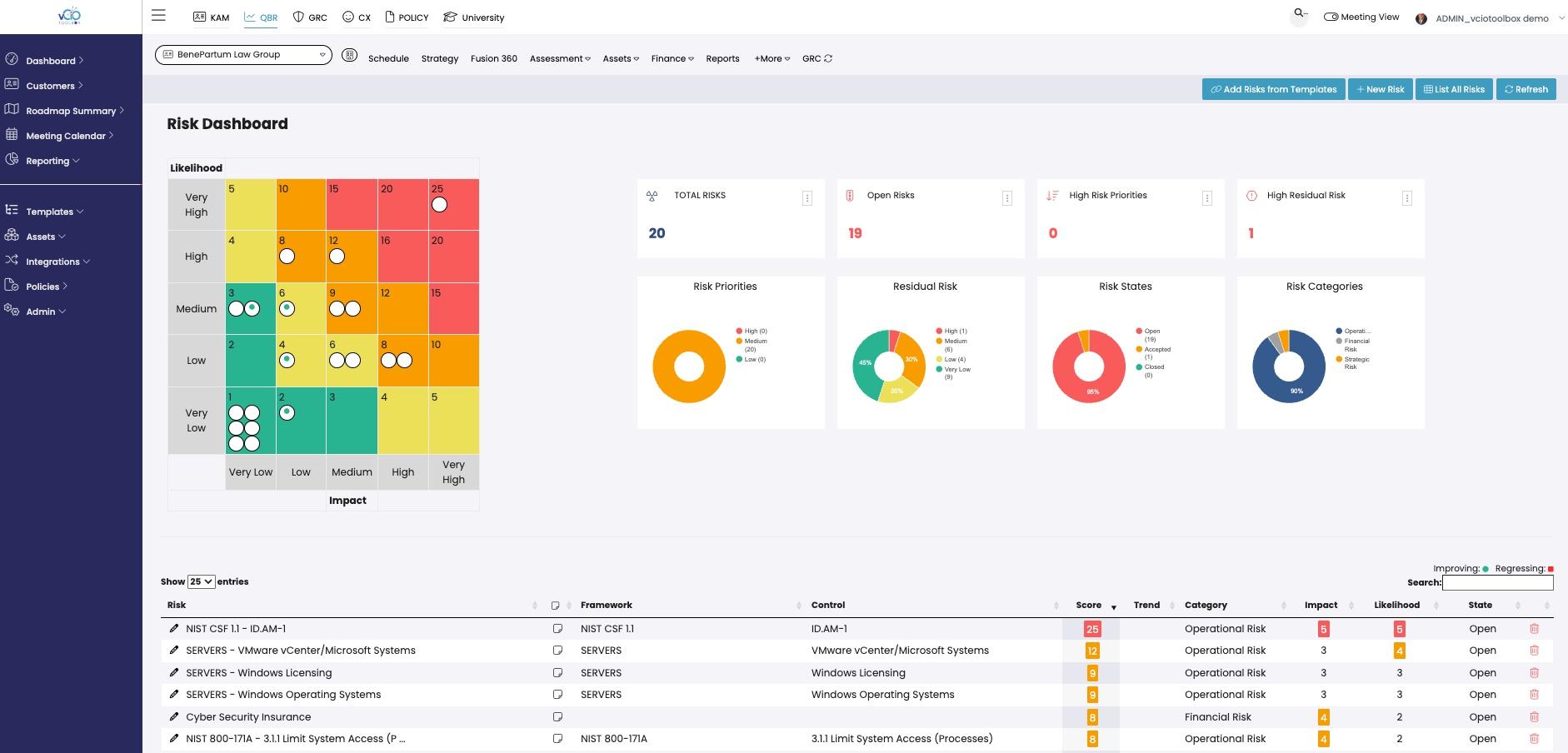
When you assign impact and likelihood ratings and let them generate a heat map, the conversation changes immediately. Clients get it intuitively — they understand the idea of moving from red to green. Suddenly you’re not arguing about priorities; you’re looking at the same picture and making decisions together.
That’s a fundamentally different relationship than the one where you hand over a report and hope it lands.
IT Risk Is Only Part of the Story
Here’s where most platforms stop short. They treat the risk register as a purely technical tool — patch status, vulnerability counts, backup health. Those things matter, but they’re not the whole picture.
The most valuable risk conversations I have with clients pull in financial exposure, operational dependencies, and strategic blind spots alongside the technical risks. When you bring all of that under one umbrella, the risk register stops being an IT deliverable and starts being an executive tool.
That’s the shift that gets you into the C-suite conversation instead of the IT closet.
Clients Should Be in the Register, Not Just Reading It
One of the things we’re intentional about is extending ownership of the risk register to the client. Not just sharing it — actually letting them participate in maintaining it. Assigning risk owners internally. Updating statuses. Flagging new concerns.
When clients have a hand in the process, two things happen. First, they stay engaged between QBRs because the register is a living document, not a quarterly snapshot. Second, they feel genuine accountability for outcomes — which means they’re more likely to act on recommendations instead of deferring them indefinitely.
That’s the difference between a vendor relationship and a strategic partnership.
The Bottom Line
The risk register isn’t a report. It’s a framework for ongoing strategic dialogue — one that spans IT, finance, operations, and compliance in a single view. Used right, it’s one of the most powerful tools you have for demonstrating value, deepening client relationships, and positioning yourself as more than a break-fix provider.
If you’re not using it that way yet, that’s the opportunity sitting right in front of you.